All videos
Jobs · 2:38
What is a job
What starts a job, the one action it runs, what it passes on and what it may use.
Transcript
0:01Welcome
This video takes one job apart, from the event that starts it to the event it passes on.
0:08One step of a workflow
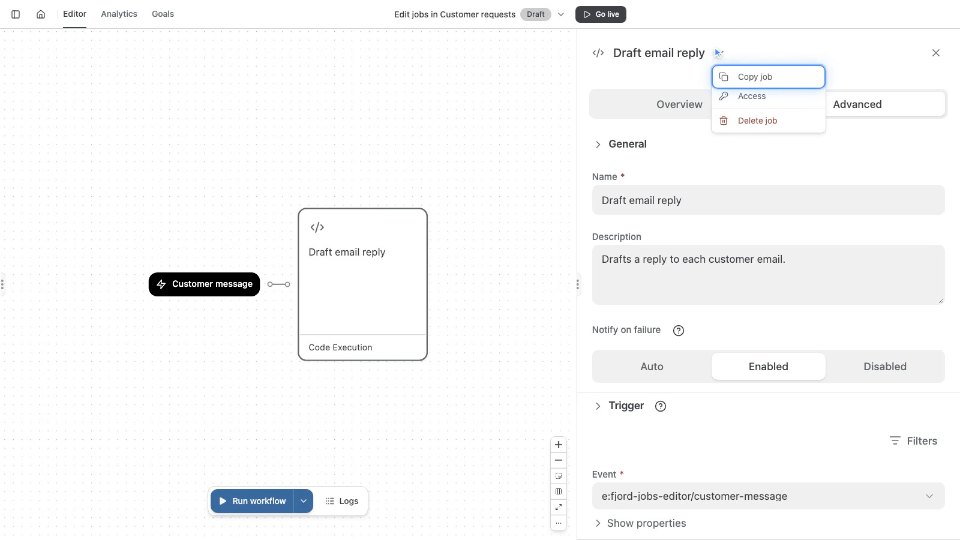
Here is the Customer requests workflow. Each job on the canvas is one step. This job writes the reply to Maya Chen about her cracked lamp shade, on order 4821. Each job waits for an event, runs one action, and can publish an event of its own.
0:27What starts a job
A job's Trigger names the one event type that starts it. The first job listens for Email received. This one listens for Request sorted, from the job before it. Filters narrow the trigger. A job without Filters runs for every event of its type. This job checks that the category is damaged item. Maya's request passes, so the job runs. When Jonas asks where his order is, his request stops at the Filters. The canvas shows Filters not met.
1:01What a job does
Once an event passes, the job runs one action. Action Type chooses which. Built-in actions include an LLM call, an Agent and Code Execution. Integrations add the actions of your connected tools. This job is an LLM call. A model writes the reply from the prompt and Maya's message, which the event carries.
1:24What a job passes on
When the action finishes, the job can publish an output event. This job publishes Reply drafted. It carries the reply the model wrote. Later jobs receive only what this event carries, so it also passes on the order number, 4821. The draft job listens for Reply drafted, so it starts next.
1:49What a job can use
LLM calls, Agents and Decisions can also attach knowledge documents. This job has Returns policy attached, so the model gets your policy when it writes. Each job runs as its own job account. Documents, databases and integration tools check that account's access. Saving the job gives that account View access to Returns policy. Share dialogs list it as Job: Write a reply.
2:17Read any job
Select a job on the canvas, and the job editor shows each part under Trigger, Action and Output event. Now you can read any job. The event that starts it, its Filters, its action, and the event it passes on. The Jobs page in the docs has every setting.